Psychology Glossary
Psychology Glossary
We live in a world where mental health has been neglected a lot. It is very important to check up on your friends, your family and even yourself. Psychology is the study of the human mind and how it functions. The more you know about it, the better. Being aware of issues we go through and asking for help is a big step. Learning more about it gives you another perspective on the world and can help you find more resources (for help). Psychologists are there to make people feel less alone and misunderstood. Here's a glossary about psychology to help you learn a little bit more about the people around you or even yourself.
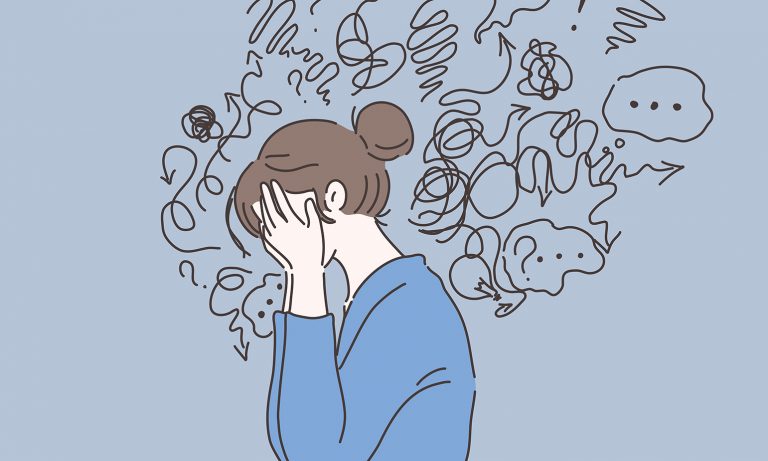
- anxiety
- noun
- A nervous disorder characterized by a state of excessive uneasiness and apprehension, typically with compulsive behavior or panic attacks.
- Example: In light of our current understanding of anxiety disorders, evaluate Freud's interpretation and handling of the Wolf-Man case.
- fr: anxiété
- cognition
- noun
- The mental action or process of acquiring knowledge and understanding through thought, experience, and the senses.
- Example: The cultural origins of human cognition.
- fr: cognition

- consultation
- noun
- A meeting with an expert or professional, such as a medical doctor, in order to seek advice.
- Example: Discussion about the different types of therapeutic consultations by Bernard Golse.
- fr: consultation

- coping
- verb
- (of a person) deal effectively with something difficult.
- Example: Beliefs About the Role of Religious Factors in coping With Depression among Cultural-Religious Groups in the UK.
- fr: faire face

- dependence
- noun
- The state of relying on or being controlled by someone or something else.
- Example: In contrast, autobiographical memories show mood dependence because the emotions causally belonged originally to the events being recalled, and the event-to-emotion situation is established strongly at the initial experience.
- fr: dépendance

- emotion
- noun
- A natural instinctive state of mind deriving from one's circumstances, mood, or relationships with others.
- Example: Furthermore, it is difficult to say that they felt 'more anxiety' is pure anxiety because they might have mixed emotion such as excitement, which may be confounded to anxiety.
- fr: émotion

- flooding
- verb
- A therapy for phobias in which clients are exposed, with their permission, to the stimuli most frightening to them.
- Example: Often this type of therapy is integrated with behavioural therapy, which emphases eliminating unwanted behaviors, which have been learnt through classical and operant conditioning, through such techniques as systematic desensitization and flooding.
- fr: inondation

- hypermnesia
- noun
- Exceptionally exact or vivid memory, especially as associated with certain mental illnesses.
- Example: Evaluating hypnotic memory enhancement (hypermnesia and reminiscence) using multitrial forced recall.
- fr: hypermnésie

- mental health
- noun
- A person’s condition with regard to their psychological and emotional well-being.
- Example: This can be seen in the use of the Diagnostic and Statistical Manual of Mental Disorders IV (DSM-IV) by many mental health practitioners today.
- fr: santé mentale

- mental illness
- noun
- Any of various disorders in which a person's thoughts, emotions, or behaviour are so abnormal as to cause suffering to himself, herself, or other people.
- Example: Researchers selected 'regular gambler' but did not exclude other mental illness, especially emotion disease.
- fr: maladie mentale
- memory
- noun
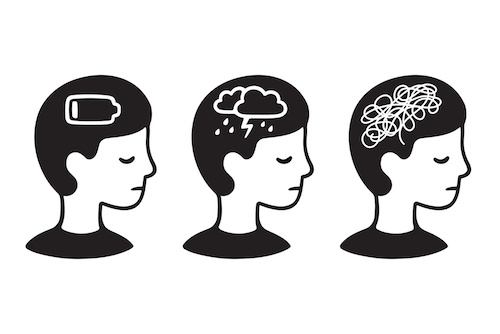
- The faculty by which the mind stores and remembers information.
- Example: Memes according to Blackmore are things which can be imitated only, and she identifies things which are not memetic in their development, for example perceptual experience, memory, learning, exploration, food preferences, communication and social relations.
- fr: mémoire

- paranoia
- noun
- A mental condition characterized by delusions of persecution, unwarranted jealousy, or exaggerated self-importance, typically elaborated into an organized system.
- Example: A person's race may result in them being persecuted by the homogeneous group in society and this could be a cause of paranoia and distress.
- fr: paranoïa

- phobia
- noun
- An extreme or irrational fear of or aversion to something.
- Example: "Wolf-Man" as Pankejeff was later referred to in Freud's case studies, was diagnosed by Freud as having an anxiety neurosis, an animal phobia in early childhood, compulsive feelings complete with obsessive rituals, attacks of furious rage and neurotic sexual conduct.
- fr: phobie

- psychoanalysis
- noun
- A system of psychological theory and therapy which aims to treat mental disorders by investigating the interaction of conscious and unconscious elements in the mind and bringing repressed fears and conflicts into the conscious mind by techniques such as dream interpretation and free association.
- Example: In the Attachment and Loss trilogy (1969, 1973 & 1980), there is evidence to show that Bowlby has integrated ideas from such a wide range of fields as psychoanalysis, ethology, experimental psychology and learning theory among other sources.
- fr: psychanalyse
- psychosocial
- adjective
- Relating to the interrelation of social factors and individual thought and behavior.
- Example: A high association between sense of humour and better psychosocial adjustment has been found in cancer patients (Dowling J, 2003).
- fr: psychosocial

- retrograde amnesia
- noun
- Amnesia caused by a trauma such as concussion, in which the memory loss relates to material learnt before the trauma.
- Example: Patients with this disorder usually suffer from some retrograde amnesia as well, but their primary deficit is the inability to store any new information in long-term memory.
- fr: amnésie rétrograde

- schizophrenia
- noun
- A long-term mental disorder of a type involving a breakdown in the relation between thought, emotion, and behavior, leading to faulty perception, inappropriate actions and feelings, withdrawal from reality and personal relationships into fantasy and delusion, and a sense of mental fragmentation.
- Example: It has been shown that unpopular children are more likely to have psychological difficulties such as schizophrenia, anxiety disorders, mood disorders and criminal behaviour.
- fr: schizophrénie

- stress
- noun
- A state of mental or emotional strain or tension resulting from adverse or very demanding circumstances.
- Example: The last group, insecure-disorganized only include 2% of children with babies not being able to handle the stress of separation and exhibiting disorganized behaviour.
- fr: stress

- stuttering
- verb
- Talk with continued involuntary repetition of sounds, especially initial consonants.
- Example: Subjects of Milgram's experiment exhibited signs of extreme nervousness and started displaying sweating, trembling, stuttering, biting lips, groan and dug their fingernails into their flesh.
- fr: bégaiement

- therapy
- noun
- Treatment intended to relieve or heal a disorder.
- Example: After years of unproductive therapy, Freud believed that the key to Wolf-Man's condition lay in a dream he had just before he was four.
- fr: thérapie

